Regenative Labs Announces Latest Research Findings on Paraspinal Muscles and Entheses of the Cervical Spine
PENSACOLA, Fla., July 29, 2026

Press Release Disclaimer: This is a press release distributed through the XPR Media network. It has not been independently verified by our newsroom.
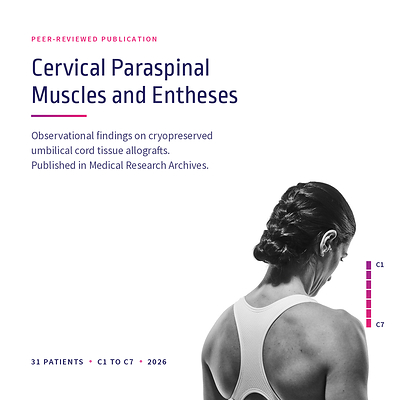

Regenative Labs Announces Latest Research Findings on Paraspinal Muscles and Entheses of the Cervical Spine
PR Newswire
PENSACOLA, Fla., July 29, 2026
Thirty-one-patient study in Medical Research Archives reports patient-reported pain and function scores following ultrasound-guided application across C1 to C7, with no adverse events observed
PENSACOLA, Fla., July 29, 2026 /PRNewswire/ — Regenative Labs, an FDA-registered manufacturer of cryopreserved Wharton’s Jelly allografts, today announced the publication of a peer-reviewed observational study in Medical Research Archives, the journal of the European Society of Medicine. The study documents patient-reported outcomes for 31 individuals who received cryopreserved human umbilical cord tissue allograft applications for defects affecting the paraspinal muscles and entheses of the cervical spine. The authors reported reductions in average pain and function scores from initial visit to final visit across all application groups, and reported that no adverse events or complications were observed during the study period. Data was collected from an observational repository overseen by Regenative Labs.
Read the full study in Medical Research Archives.
Study design
Across multiple participating clinics, 31 patients with imaging-confirmed cervical paraspinal muscle degeneration and enthesopathy received one to three ultrasound-guided applications of a cryopreserved umbilical cord tissue allograft, placed at targeted sites spanning C1 to C7. Each application delivered 2 mL (150 mg) of allograft. All patients had exhausted at least three months of conservative care prior to application. Outcomes were tracked using the Numeric Pain Rating Scale (NPRS) and the Western Ontario and McMaster Universities Arthritis Index (WOMAC).
The study, “Human Umbilical Cord Tissue Allografts for Cervical Paraspinal Muscle and Entheses,” was authored by Conrad Tamea, Jeff Buchalter, Jason Capra, Tracie Gilliland, Heather Johnson, Lonnie Peets, Naomi Lambert, Alexis Lee, and Tyler Barrett.
Read the full study in Medical Research Archives.
Reported outcomes
The authors reported reductions in average NPRS and WOMAC scores from the initial visit to the final visit across all application groups. In the within-group analyses, the authors reported statistically significant reductions in pain and WOMAC measures for the single and double application groups across their respective timelines, and statistically significant reductions across all measured scales in the triple application group from the initial visit to the final visit. The authors reported improvements in quality-of-life scores in the single and triple application groups. The authors reported that no adverse events or complications were observed during the study period.
|
Measure |
Single application |
Double application |
Triple application |
|---|---|---|---|
|
NPRS (pain) |
5.20 to 4.13 |
6.00 to 3.11 |
7.00 to 1.86 |
|
WOMAC Total |
39.73 to 22.80 |
35.44 to 33.67 |
51.57 to 43.29 |
Mean patient-reported scores from initial to final visit, as reported by the authors. Lower NPRS and WOMAC scores indicate improvement. Patients were not randomized to application groups, and comparisons between application groups are not reported here.
Structural rationale
Human umbilical cord tissue contains a collagen-rich extracellular matrix. In the published discussion, the authors describe the structural similarity between this matrix and the collagen and fibrocartilage of the cervical paraspinal entheses and muscle as a basis for using the allograft to supplement and support defective tissue in homologous locations.
Company comment
“Birth tissue allografts continue to draw interest in healthcare markets worldwide, and that interest has to be met with rigorous research and transparent reporting,” said Tyler Barrett, Chief Executive Officer of Regenative Labs and a co-author of the study. “Publishing observational data as the authors recorded it, including the measures that moved less than others, is how a real evidence base gets built. That is the standard we hold ourselves to.”
This publication adds to a library of 19 peer-reviewed papers Regenative Labs has contributed to on the characterization and homologous use of birth tissue allografts, spanning joint and musculoskeletal, foot and ankle, and wound applications. The company will continue to invest in observational research and transparent reporting of patient-reported outcomes. As we work to obtain the official documentation needed to export our scientifically backed products, we will continue conducting rigorous and transparent research into the uses and impact of regenerative medicine.
Physicians interested in the published evidence library or in participating in the observational repository can contact Regenative Labs at regenativelabs.com.
Citation:
Tamea C, Buchalter J, Capra J, Gilliland T, Johnson H, Peets L, Lambert N, Lee A, Barrett T. Human Umbilical Cord Tissue Allografts for Cervical Paraspinal Muscle and Entheses. Medical Research Archives. 2026;14(6). doi:10.18103/mra.2026.0299
Media Contact
Evan Dempsey
Marketing Director
Regenative Labs
800-891-3452 | Info@RegenativeLabs.com
 View original content to download multimedia:https://www.prnewswire.com/news-releases/regenative-labs-announces-latest-research-findings-on-paraspinal-muscles-and-entheses-of-the-cervical-spine-302837317.html
SOURCE Regenative Labs