The American Customer Satisfaction Index (ACSI): Quarter 2, 2026 Economic Alarm Bells are Blasting — Is Anybody Listening
Key Takeaways: The correlation between corporate profit and customer satisfaction is turning increasingly negative,

Press Release Disclaimer: This is a press release distributed through the XPR Media network. It has not been independently verified by our newsroom.


As of the second quarter of 2026, the American Customer Satisfaction Index (ACSI®) declined sharply, the size of which was surpassed only once before in this century — when the COVID-19 pandemic caused major supply shortages and led to large price increases.
This press release features multimedia. View the full release here: https://www.businesswire.com/news/home/20260811157072/en/
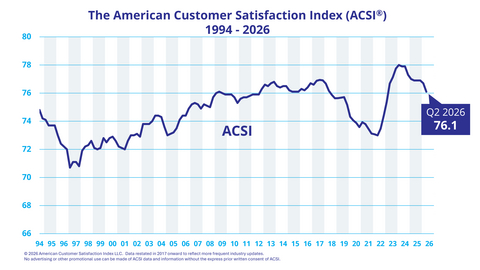
ACSI 1994-2026
At an annual rate of just 1.5%, GDP growth is also weak. GDP is highly dependent on consumer spending, which is its largest component. Yet despite continued inflation and weaker customer satisfaction, consumer spending has increased, driven by a small proportion of affluent households. Without this increase, GDP growth would have been negative.
According to the U.S. Bureau of Economic Analysis, pretax corporate profits are at record levels, but per ACSI data, so are customer complaints. This is a dangerous combination because pent-up customer defection now looms even more treacherous than before. If realized, it would create a complicated challenge, with potentially severe consequences for companies with weak customer satisfaction that have relied on pricing power and benefited from high customer switching costs.
This risk can only be mitigated by improving the buying and consumption experience of customers, using analytics compatible with the properties of customer satisfaction data and performance metrics linked to financial results. However, many companies use performance metrics that are too noisy or irrelevant for improving customer satisfaction. While some accurately predict directional change in customer experience, stock returns, or profit about 50% of the time, so would a coin toss.
At the macro level, the divergence between buyer utility (or satisfaction) and seller profit implies that companies are charging more while supplying less. This creates a welfare loss in economic terms, with profits disproportionately going to owners of capital. It is incompatible with sustainable economic growth and occurs due to market concentration, where companies have strong pricing power and customers face significant switching costs.
Is anybody listening to the warning signs? Customer satisfaction is falling and becoming more compressed across companies. And while customer complaints have reached record heights, market concentration has increased with weak economic growth and ongoing high inflation. In fact, some are listening and not only taking precautionary action, but reaping abnormally high returns to boot. Consider this: Despite a weak economy, the S&P 500 is at a record high due to record profits. Nevertheless, year-to-date the ACSI ETF, which holds about 30-35 top customer satisfaction companies in their respective markets, has outperformed the S&P 500. Apparently, a few companies and investors have recognized the economic peril and acted accordingly.
“If the pent-up customer defection materializes, companies with both high customer satisfaction and high customer retention will benefit not only from downside protection, but also from strong stock returns,” said Claes Fornell, founder of the ACSI and the Distinguished Donald C. Cook Professor (Emeritus) of Business Administration at the University of Michigan. “It is customer retention, particularly at high levels, that causes exponential profit growth. Long term, it is better that such growth comes from satisfied rather than captive customers.”
Similarly, for long-term economic growth, the negative correlation between corporate profits and customer satisfaction must be reversed. Record seller profits and record buyer complaints are not a sign of a healthy economy.
Claes Fornell, the Donald C. Cook Distinguished Professor of Business (Emeritus) at the University of Michigan, is the primary author of this press release. According to Google Scholar, Professor Fornell is the most cited person in the world on customer satisfaction and one of the most cited econometricians/statisticians with respect to structural equation models with unobservable variables and measurement error. He holds honorary doctorates from several universities.
For more, follow the American Customer Satisfaction Index on LinkedIn or visit www.theacsi.com.
No advertising or other promotional use can be made of the data and information in this release without the express prior written consent of ACSI LLC.
About the ACSI
The American Customer Satisfaction Index (ACSI®) is a national economic indicator and a leading provider of customer analytics products that help organizations build lasting customer relationships and prove ROI on experience investments. ACSI’s AI-enhanced platform delivers intuitive dashboards and cause-and-effect analytics that pinpoint the quality drivers most predictive of customer allegiance, retention, price tolerance, and financial performance. ACSI data has been shown to correlate strongly with key micro and macroeconomic indicators, including consumer spending, GDP growth, earnings, and stock returns.
Founded in 1994 at the University of Michigan’s Ross School of Business, the ACSI measures customer satisfaction with more than 400 companies in over 40 industries, including federal government services, based on approximately 200,000 annual interviews. Learn more at https://www.theacsi.com.
ACSI and its logo are Registered Marks of American Customer Satisfaction Index LLC.
View source version on businesswire.com: https://www.businesswire.com/news/home/20260811157072/en/
Media gallery