120 Million AI Pay Transactions in a Single Week: AI Shopping Agents Move From Theory to Checkout
Agentic commerce is beginning to move from forecast to real-world use in some markets. In China, AI agents are already

Press Release Disclaimer: This is a press release distributed through the XPR Media network. It has not been independently verified by our newsroom.


The debate is shifting as early examples show AI shopping agents completing transactions in some markets. According to NielsenIQ (NYSE: NIQ), a leading consumer intelligence company, its global report The Commerce Revolution: Where East Meets West points to agentic commerce moving from experiment toward everyday infrastructure. According to Ant Group, Alipay AI Pay processed more than 120 million transactions during the week of February 5–11, 2026, while Adobe Analytics reported that traffic from generative AI sources to US retail websites increased by 1,200% between July 2024 and February 2025.
This press release features multimedia. View the full release here: https://www.businesswire.com/news/home/20260730837106/en/
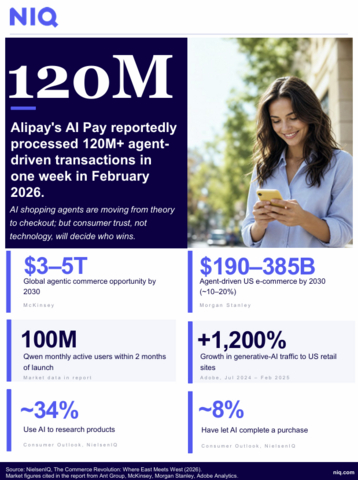
Agentic commerce is beginning to move from forecast to real-world use in some markets. In China, AI agents are already completing purchases at meaningful scale, and analysts now put the global opportunity at $3–5 trillion by 2030.
This is the second release in NielsenIQ’s mid-year read of the global commerce shift, building on evidence that retail’s center of gravity has moved East. AI is emerging as the connective layer across commerce formats—from live and social to quick commerce. Yet NielsenIQ’s own consumer data shows a clear gap between AI capability and shopper trust. While consumers are increasingly comfortable using AI to research and recommend, few are ready to let it complete purchases.
“While much of the West is still debating whether AI will shop for us, in parts of Asia it already is, quietly completing purchases at a scale most boardrooms haven’t registered,” said Emilie Darolles, President West Europe at NielsenIQ. “But the real story is not just what AI can do — it’s what shoppers will allow it to do. Consumers are increasingly happy to let AI research and recommend, yet very few are ready to let it buy. The next phase of agentic commerce will be won by the brands that earn enough trust to be chosen by both the consumer and the agent.”
The “must-know” numbers
- Agents are already transacting at scale. According to Ant Group, Alipay AI Pay processed more than 120 million transactions during the week of February 5–11, 2026. The report also cites market data that Alibaba’s Qwen assistant reached 100 million monthly active users within two months of launch.
- The money is following. Analysts size the global agentic commerce opportunity at $3–5 trillion by 2030 (McKinsey), with agents projected to drive $190–385 billion (roughly 10–20%) of US e-commerce by 2030 (Morgan Stanley).
- Discovery is shifting to machines. Adobe Analytics reported that traffic from generative AI sources to US retail websites increased by 1,200% between July 2024 and February 2025. Adobe also found that visitors arriving from generative AI sources showed stronger engagement, including more pages per visit and lower bounce rates, even though conversion still trailed more established traffic sources.
- Autonomy is still rare. NielsenIQ data shows AI is reshaping the “messy middle”: around 34% of consumers use AI to research products and 23% to summarize reviews, yet only about 8% have let AI complete a purchase for them. Influence is running well ahead of automation.
For brands, the shift from a human funnel to an agent-mediated one changes the rules of visibility. When an AI agent shortlists three products, the traditional path from impression to click to cart collapses. Brands with incomplete or machine-unreadable product data risk becoming invisible to the systems that increasingly decide what gets bought.
But the East–West story cuts both ways. China is proving the demand side (agents at consumer scale) while the West builds the trust and measurement rails that make agentic commerce safe for high-consideration and everyday purchases alike. The winners will be the brands that prepare now: structuring product data, earning their place in AI consideration sets, and measuring performance in a world where the shopper may be a machine.
About the report
The Commerce Revolution: Where East Meets West analyzes the convergence of Eastern and Western commerce models across live commerce, social commerce, quick commerce, retail media networks, and emerging agentic commerce. It draws on NIQ Consumer Outlook, Retail Pulse, Digital Purchases, and Omnisales data, alongside third-party sources including McKinsey, Morgan Stanley, and Adobe.
About NIQ
NielsenIQ (NYSE: NIQ) is a leading consumer intelligence company, delivering the most complete and trusted understanding of consumer buying behavior and revealing new pathways to growth. By combining an unmatched global data footprint and granular consumer and retail measurement with decades of AI modeling expertise, NIQ builds decision systems that help companies turn complex data into confident action.
With operations in more than 90 countries, NIQ covers approximately 82% of the world’s population and more than $7.4 trillion in global consumer spend. Through cloud-based platforms, advanced analytics and AI-driven insights, NIQ delivers The Full View™—helping brands and retailers understand what consumers buy, why they buy it, and what to do next.
For more information, please visit www.niq.com.
Forward-Looking Statements
This press release contains forward-looking statements within the meaning of applicable securities laws, including statements regarding market trends, projected growth of live, social, quick, retail-media, and agentic commerce, and the anticipated impact on brands and retailers. These statements are based on NIQ’s current expectations and assumptions and are subject to risks and uncertainties that could cause actual results to differ materially. Third-party figures (including estimates attributed to McKinsey, Morgan Stanley, and Adobe) have not been independently verified by NIQ. NIQ undertakes no obligation to update any forward-looking statement except as required by law.
Notes to Editors
Figures in this release come from two types of source, both drawn from NielsenIQ’s The Commerce Revolution: Where East Meets West (April 2026).
NielsenIQ proprietary data: the consumer AI-adoption figures — the share of consumers using AI to research products (~34%), to summarize reviews (~23%), and to complete a purchase (~8%) — from NIQ Consumer Outlook and related NielsenIQ consumer data.
Market figures cited in the report (not NielsenIQ-measured): According to Ant Group, Alipay AI Pay processed more than 120 million transactions during the week of February 5–11, 2026. The report also cites market data that Alibaba’s Qwen assistant reached 100 million monthly active users within two months of launch. McKinsey estimates a $3–5 trillion global agentic-commerce opportunity, while Morgan Stanley projects agents could drive $190–385 billion of U.S. e-commerce by 2030. Adobe Analytics reported a 1,200% increase in traffic from generative AI sources to U.S. retail websites between July 2024 and February 2025.
Frequently asked questions
What is agentic commerce? It’s when AI agents don’t just recommend products but autonomously discover, evaluate, and complete purchases on a shopper’s behalf, using real-time data like price, availability, and preferences.
What’s the single biggest finding? AI agents are already transacting at massive scale in Asia (over 120 million agent-driven transactions in a single week (February 2026) via Alipay’s AI Pay) even as most Western consumers have not yet let AI buy for them.
Isn’t this just the same AI story everyone is telling? No. Rather than “AI is coming,” this release quantifies where agentic commerce is already real (the East), sizes the opportunity ($3–5T by 2030), and adds a reality check most coverage misses: influence is far ahead of autonomy, with only ~8% of consumers letting AI complete a purchase.
Where do the figures come from? NIQ Consumer Outlook and related NielsenIQ consumer data for the adoption figures, with third-party estimates (McKinsey, Morgan Stanley, Adobe) and market data (Alipay, Alibaba) attributed where cited.
What should brands do now? Structure product data for machine readability, build presence in AI consideration sets, and adopt measurement built for a world where the “shopper” may be an AI agent.
NIQ-GENERAL
View source version on businesswire.com: https://www.businesswire.com/news/home/20260730837106/en/
Media gallery