
AI Infrastructure Market Projected to Reach USD 353.0 Billion at a 27.12% CAGR by 2035
AI Infrastructure Market is accelerating as demand rises for high-performance computing, GPUs, cloud platforms, and

Press Release Disclaimer: This is a press release distributed through the XPR Media network. It has not been independently verified by our newsroom.
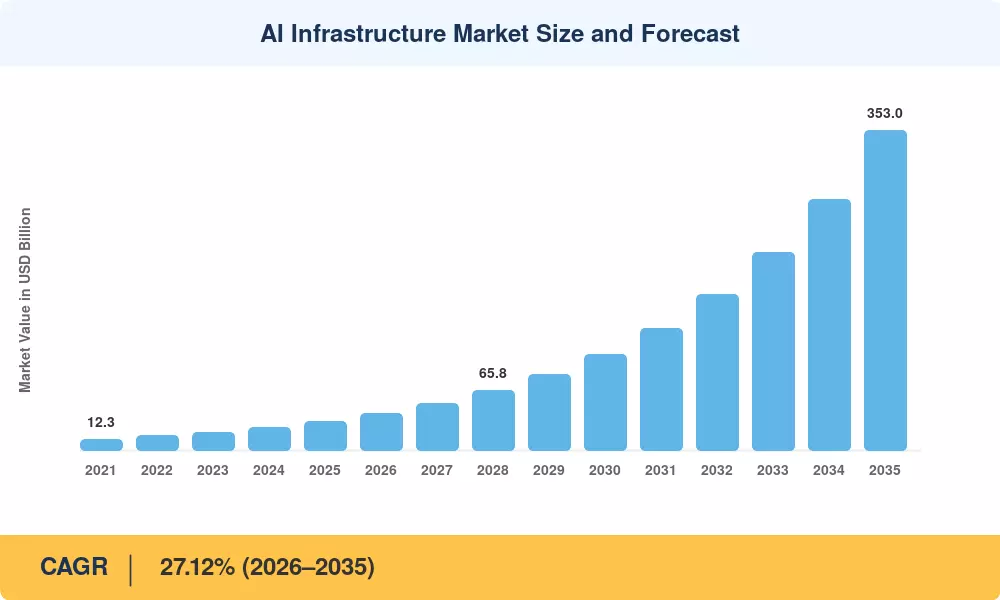

AI Infrastructure Market is accelerating as demand rises for high-performance computing, GPUs, cloud platforms, and AI-ready data centers
NEW YORK, NY, UNITED STATES, August 6, 2026 /EINPresswire.com/ — AI infrastructure has become the backbone of modern computing, encompassing the GPUs, specialised chips, high-performance networking, storage, and orchestration software that let organisations train and run machine learning models at scale. What began as a niche concern for research labs and hyperscalers has turned into a boardroom priority, as enterprises across healthcare, finance, retail, and manufacturing race to embed AI-driven decision-making into their core operations and discover that doing so requires an entirely new category of compute investment.
The global AI Infrastructure Market was valued at approximately USD 25.2 Billion in 2024 and is projected to grow from about USD 32.03 Billion in 2025 to roughly USD 353.0 Billion by 2035, reflecting a CAGR of 27.12% across the forecast period. This exceptional growth rate reflects how central compute capacity has become to competitive strategy: hyperscalers have overtaken capital-intensive utilities in absolute capital expenditure, with major cloud providers collectively signalling double-digit percentage increases in AI-related infrastructure spending as they race to secure GPU capacity and expand data centre footprints.
Cloud-based deployment currently dominates the AI infrastructure landscape, particularly across North America, while edge computing integration is gaining momentum in Asia-Pacific as organisations look to process data closer to its source and cut latency for real-time applications. Hardware still commands the largest share of spending, driven by demand for GPUs and specialised AI accelerators, while software is emerging as the fastest-growing component as businesses invest in tools to build, deploy, and manage AI models more efficiently.
Get a Sample PDF of the Report at –
https://www.marketresearchfuture.com/sample_request/30118
Market Dynamics: Drivers, Restraints and Opportunities
Rising demand for AI applications across healthcare, finance, and retail is the primary force propelling the AI Infrastructure Market forward, as organizations turn to machine learning to improve operational efficiency and customer experience. This surge in demand is compounding with rapid advancements in machine learning techniques themselves: increasingly sophisticated models require substantially more computational horsepower, and the market for dedicated machine learning infrastructure is expanding at a pace well above the broader AI infrastructure market’s own growth rate. Data center investment is scaling in parallel, as the sheer volume of data organizations generate and need to process pushes providers to build facilities specifically optimized for AI workloads rather than general-purpose computing.
Hybrid cloud adoption is reshaping how enterprises architect their AI stacks, giving businesses the flexibility to run workloads across on-premises and cloud environments depending on cost, performance, and data-residency needs. Growing cybersecurity concerns are also becoming a meaningful driver in their own right, as organizations recognize the unique vulnerabilities AI systems introduce and increasingly demand infrastructure with security built into the design rather than bolted on afterward.
Even with this momentum, the market faces real friction. The capital intensity of building AI-ready data centers is substantial, and the specialized chips at the heart of most AI workloads remain supply-constrained, creating lead times and cost volatility that complicate planning for smaller organizations. Energy consumption is an increasingly visible constraint as well, with power availability now a genuine bottleneck for new data center construction in several regions, pushing sustainability and energy-efficient design from a nice-to-have into a core infrastructure requirement. Regulatory uncertainty around AI governance, combined with the technical complexity of integrating new AI infrastructure with legacy IT systems, adds further friction for enterprises still early in their AI adoption journey.
These pressures are also opening substantial opportunities. The development of specialized AI hardware purpose-built for specific workload types promises meaningful efficiency gains over general-purpose chips, and vendors that can deliver measurably better performance-per-watt stand to capture an outsized share. Deeper integration of AI-driven analytics directly into cloud service offerings is giving businesses real-time insight without requiring them to build custom infrastructure from scratch, while the expansion of edge computing is opening a large addressable market among organizations that need decentralized AI processing for latency-sensitive applications in manufacturing, automotive, and security. Sustainability-focused infrastructure design is emerging as a genuine differentiator rather than a compliance checkbox, as enterprises increasingly weigh environmental impact alongside raw performance when selecting infrastructure partners.
Key Players and Competitive Insights
The AI Infrastructure Market is moderately fragmented, combining a handful of dominant hyperscalers and chipmakers with a growing field of specialized startups targeting niche AI workloads. Competitive differentiation increasingly centers on performance optimization, cost efficiency, and how well a vendor’s stack handles AI inference at scale, rather than on price alone.
Leading companies in the global AI Infrastructure Market include NVIDIA, Amazon, Google, Microsoft, IBM, Intel, Oracle, Alibaba, Baidu, and Tencent. NVIDIA continues to dominate through its GPU technology and has extended its lead with new AI supercomputing platforms aimed at accelerating machine learning workloads across industries from healthcare to finance. Amazon is expanding AI-driven tooling within its cloud platform to simplify machine learning deployment for businesses, while Microsoft is investing heavily in AI research and embedding AI capabilities across its product suite, including through partnerships focused on responsible AI development. China’s major technology players Alibaba, Baidu, and Tencent anchor the competitive landscape across Asia-Pacific, each building out their own cloud and AI infrastructure stacks to serve a rapidly growing regional customer base.
Buy this Premium Research Report at –
https://www.marketresearchfuture.com/checkout?currency=one_user-USD&report_id=30118
Market Segmentations
By Component
• Hardware
• Software
• Services
By Deployment Model
• On-Premise
• Cloud
• Hybrid
By Application
• Natural Language Processing
• Computer Vision
• Machine Learning
• Predictive Analytics
• Virtual Assistants
By Target Industries
• Healthcare
• Financial Services
• Manufacturing
• Retail
• Transportation
By Region
• North America
• Europe
• Asia-Pacific
• South America
• Middle East & Africa
Regional Insights
North America leads the AI Infrastructure Market, commanding roughly 45% of global share on the back of heavy technology and innovation investment, regulatory support for AI initiatives, and a deep startup ecosystem. The United States is the primary contributor, home to major players such as NVIDIA, Amazon, Google, and Microsoft, and benefits from advanced research institutions and a highly skilled workforce that reinforce its position as the global leader in AI infrastructure development.
Europe holds around 30% of the global market and is emerging as a significant force, supported by strong governmental initiatives including the European Commission’s digital strategy. Germany and the United Kingdom are leading regional investment, driven by digital-transformation needs across industries, while the region’s emphasis on ethical AI and data protection is shaping infrastructure design choices to align with strict regulatory frameworks.
Asia-Pacific accounts for approximately 20% of the global market and is growing rapidly, propelled by rising technology investment in China and India, government initiatives promoting AI adoption, and increasing demand for automation across manufacturing and services. China’s Alibaba, Baidu, and Tencent are central to the region’s competitive landscape, and smart-city and digital-transformation initiatives are further boosting demand. The Middle East and Africa remain a smaller but emerging market, holding about 5% of global share, with the UAE and South Africa leading investment supported by government programs aimed at fostering innovation and digital transformation.
Browse A Full Report: (Including Full TOC, List Of Tables & Figures, and Chart) –
https://www.marketresearchfuture.com/reports/ai-infrastructure-market-30118
Recent Developments
Hyperscalers and chipmakers have been moving aggressively to expand AI compute capacity. NVIDIA announced the launch of a new AI supercomputer designed to accelerate machine learning tasks and enhance data processing across industries ranging from healthcare to finance, reinforcing its leadership position amid surging demand for high-performance computing. Amazon unveiled a new suite of AI-driven tools within its AWS platform aimed at simplifying machine learning model deployment for businesses, extending its strategy of embedding AI capability directly into its cloud offerings.
Microsoft entered into a strategic partnership with a leading AI research institute to advance the development of ethical AI technologies, underscoring the growing importance of responsible AI deployment as a competitive and reputational factor. More broadly, capital-light hyperscalers have overtaken capital-intensive utilities in total capital expenditure, with major cloud providers signaling a sharp year-over-year increase in spending on AI data centers and computing resources, a clear signal of how central infrastructure investment has become to the industry’s near-term strategy.
Frequently Asked Questions (FAQs)
Q1. What is the expected growth of the AI Infrastructure Market?
The market is projected to grow at a CAGR of 27.12% from 2025 to 2035, reaching about USD 352.99 billion by 2035.
Q2. What factors are driving the AI Infrastructure Market?
Rising demand for AI applications, advancements in machine learning, hybrid cloud adoption, and increased data centre investment are major growth drivers.
Q3. Which region dominates the AI Infrastructure Market?
North America currently leads with roughly 45% of global share, driven by heavy technology investment and a mature AI ecosystem.
Q4. What are the major challenges facing the market?
High capital intensity, chip supply constraints, rising energy consumption, and integration complexity with legacy IT systems remain key challenges.
Q5. Which component holds the largest market share?
Hardware currently leads, driven by demand for GPUs and specialised AI accelerators, while software is the fastest-growing component.
Q6. Who are the leading companies in the AI Infrastructure Market?
Major players include NVIDIA, Amazon, Google, Microsoft, IBM, Intel, Oracle, Alibaba, Baidu, and Tencent.
Q7. Which deployment model is most widely used?
Cloud deployment is the largest segment, valued for its scalability and flexibility, while hybrid deployment is the fastest-growing model.
➤ Latest Market Intelligence from Market Research Future:
Multifunctional Printer Market –
https://www.marketresearchfuture.com/reports/multifunctional-printer-market-27774
Smart Virtual Personal Assistants Market –
https://www.marketresearchfuture.com/reports/smart-virtual-personal-assistants-market-27972
Social Computing Market –
https://www.marketresearchfuture.com/reports/social-computing-market-28000
Data Center Precision Air Conditioning Market –
https://www.marketresearchfuture.com/reports/data-center-precision-air-conditioning-market-28040
Biometrics As A Service Market –
https://www.marketresearchfuture.com/reports/biometrics-as-a-service-market-28048
Data Center Asset Management Market –
https://www.marketresearchfuture.com/reports/data-center-asset-management-market-28060
Digital Rights Management Market –
https://www.marketresearchfuture.com/reports/digital-rights-management-market-28066
Virtual Event Software Market –
https://www.marketresearchfuture.com/reports/virtual-event-software-market-28083
Virtual Client Computing Market –
https://www.marketresearchfuture.com/reports/virtual-client-computing-market-28092
Virtualization Software Market –
https://www.marketresearchfuture.com/reports/virtualization-software-market-28102
Vr Gambling Market –
https://www.marketresearchfuture.com/reports/vr-gambling-market-28104
Sagar Kadam
Market Research Future
+ +1 628-258-0071
email us here
Legal Disclaimer:
EIN Presswire provides this news content “as is” without warranty of any kind. We do not accept any responsibility or liability
for the accuracy, content, images, videos, licenses, completeness, legality, or reliability of the information contained in this
article. If you have any complaints or copyright issues related to this article, kindly contact the author above.

Media gallery

