Amazon’s Shopping AI Recommends Products That Never Appear in Search Results
New research finds 63.9% of Amazon AI recommendations fall outside the organic top 10. Prime Clicks publishes a free

Press Release Disclaimer: This is a press release distributed through the XPR Media network. It has not been independently verified by our newsroom.
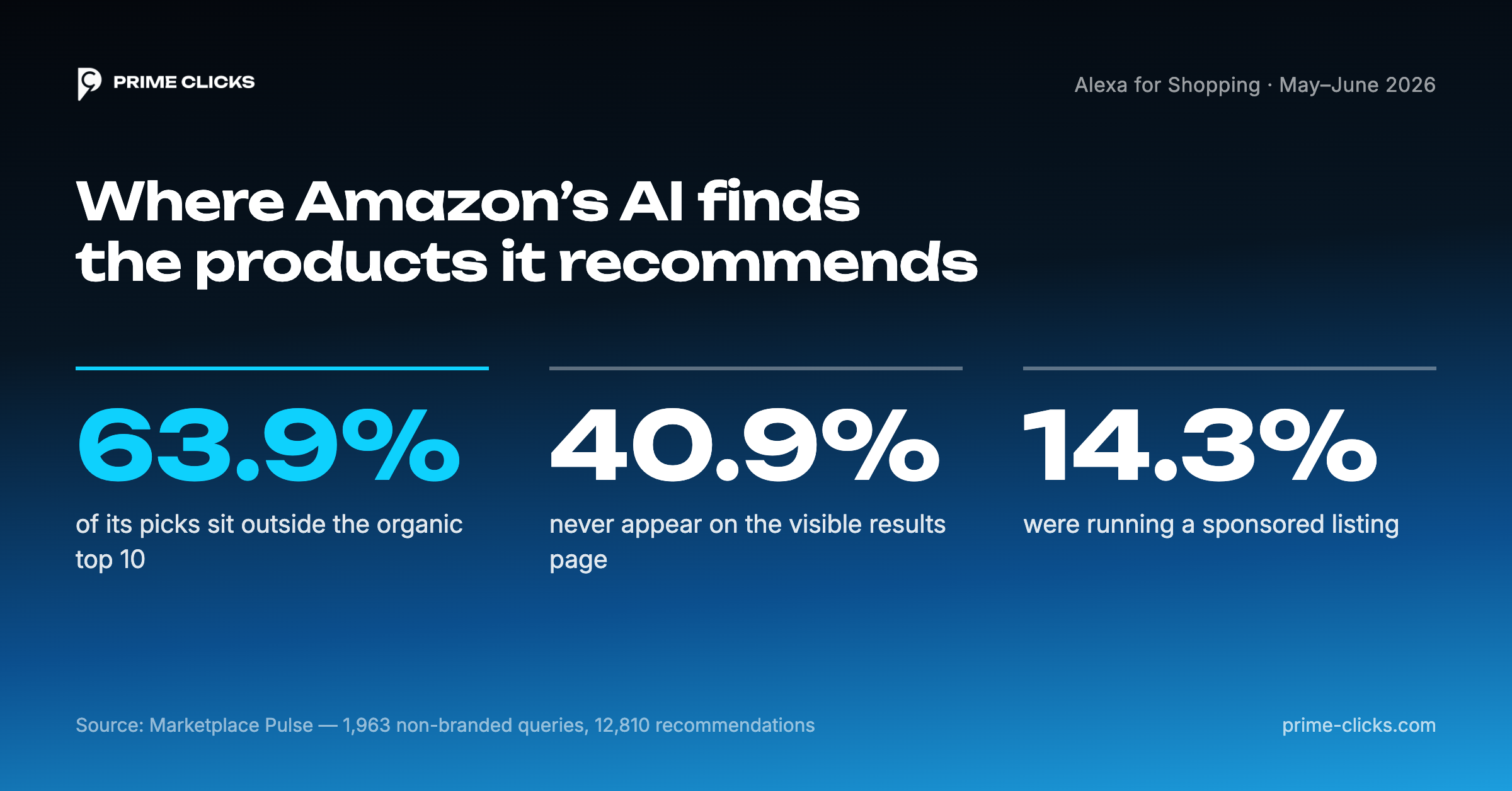

New research finds 63.9% of Amazon AI recommendations fall outside the organic top 10. Prime Clicks publishes a free five-step audit for sellers.
NEW YORK, NY, UNITED STATES, August 28, 2026 /EINPresswire.com/ — Nearly two in five products that Amazon’s AI shopping assistant recommends to shoppers never appear on the search results page at all.
Marketplace Pulse published that finding in July 2026, after analyzing 1,963 non-branded queries and 12,810 recommendations captured over May and June. Asked to recommend something rather than list options, the assistant went well past the first page. Some 63.9% of its picks sat outside the organic top 10 for the matched search term. Another 40.9% never showed up on the visible results page at all.
Marketplace Pulse called it a third shelf, sitting alongside organic results and paid placements, and one that sellers cannot buy or rank their way onto.
Amazon sellers have spent twenty years fighting for position on a page. Position is the one thing this assistant does not look at.
THE SEARCH BAR BECAME A CONVERSATION
Amazon renamed Rufus to Alexa for Shopping on May 13, 2026 and merged it with Alexa+. It answers in the main search bar, writes category overviews, builds comparisons and follows shoppers from the app to Echo. Prime membership is not required to meet it.
By Amazon’s own reporting, 300 million customers used it in 2025, worth roughly $12 billion in incremental annualized sales, with monthly active users up more than 115% in Q1 2026.
A shopper who once typed a keyword, scanned fifty results and opened four tabs now asks a question and gets five products with reasons attached. The comparison that lived across those tabs happens inside one answer, written from listing data the shopper never sees.
TWO READERS, ONE PRODUCT PAGE
Google went the other way. AI Overviews there replace the click, and zero-click searches hit roughly 68% of Google searches in early 2026. Amazon’s assistant does the opposite and shortens the trip to checkout. Marketplace Pulse tracked US sessions on Black Friday 2025 and found sessions ending in a sale up 100% year over year when the assistant was involved, against 20% without it.
A bad answer costs different people different things. On Google it costs a publisher traffic. On Amazon it costs the seller the sale, right at the point where the shopper is choosing between two products.
Which leaves the product page with two readers. The human one skims a title, three bullets and the hero image. The other reads the structured attribute fields most sellers leave blank, then goes looking at A+ content, community Q&A, reviews and the brand’s own website. Where two of those disagree it picks a winner, and the seller gets no say in which.
WHERE PRODUCT DATA FAILS
Prime Clicks, an Amazon Ads Advanced Partner, has been running structured audits of what the assistant says about client products. Brands going through it found more than half of their live content contained errors, the agency reports, and most had left roughly half of their backend attribute fields empty.
Blank fields are the cheapest mistake to make and the hardest to notice. The assistant fills them with a plausible estimate, or drops the product from the comparison. Wrong data, a superseded formula or an old pack count, comes back to shoppers stated as fact. And when bullets, A+ content and the brand site contradict one another, the assistant picks whichever it likes.
One audit of a whey protein powder found the first bullet claiming 24 g of protein while the nutrition panel, the title and the brand website all said 30 g. Nowhere did the listing state a serving size, so the assistant made one up, guessing 33 to 36 grams against an actual scoop of 46 g. Work out cost per serving from that and the tub looks like it holds 35% more servings than it does.
“Nobody can optimize the answer, because there is no formula to optimize against. Amazon has never published one,” said Artem Burmistrov, CEO at Prime Clicks. “What you can do is fix the inputs, then go and check the output. Most sellers have never read a single thing the assistant says about their own product.”
HOW SELLERS SHOULD ADAPT
Prime Clicks has put its client method into a free guide, which walks sellers through how to audit what Alexa for Shopping knows about your product. Build a knowledge map of verified facts from the physical label and the manufacturer spec sheet, not the listing. Diff the live listing against it. Run 20 to 30 structured questions per ASIN from a logged-out browser. Route every failure back to the field that caused it. Then wait two to four weeks, ask the identical questions again, and score the difference.
Order matters more than it looks. Skip the map and the audit only catches errors the assistant repeats back, leaving any false claim already sitting in the listing untouched. Ask from a logged-in account and the answers cannot be reproduced, because the assistant personalizes on browsing history.
There is a deadline attached. Titles in most categories have capped at 75 characters since July 27, 2026, with a new 125-character Item Highlights field taking the overflow. That change moves the spec detail the assistant likes to quote out of titles and into Item Highlights and bullets, so sellers running the two projects separately rewrite the same fields twice.
Artem is candid about the limits. Most product discovery on Amazon still runs through search results and ads, so keyword work and ad structure are not going anywhere.
“None of this is exotic. It is ordinary Amazon listing optimization work, with a second audience reading it,” he said. “The argument for doing it now is that the surface is young and the work is cheap, and every fix helps human shoppers anyway.”
ABOUT PRIME CLICKS
Prime Clicks is a full-service Amazon marketing agency and an Amazon Ads Partner, working with brands across advertising, listing optimization and account management. The agency publishes free operational guides for Amazon sellers at prime-clicks.com.
MEDIA CONTACT
Artem Burmistrov, CEO, Prime Clicks
Contact@prime-clicks.com · prime-clicks.com
Artem Burmistrov
Prime Clicks
email us here
Legal Disclaimer:
EIN Presswire provides this news content “as is” without warranty of any kind. We do not accept any responsibility or liability
for the accuracy, content, images, videos, licenses, completeness, legality, or reliability of the information contained in this
article. If you have any complaints or copyright issues related to this article, kindly contact the author above.

Media gallery