Bone Regeneration: Study Reveals β1 Integrin & DDR2 Cooperation
New study finds β1 integrin and DDR2 receptors cooperate to control skeletal progenitor cells, enhancing bone regeneration and offering new therapeutic strategies.

Press Release Disclaimer: This is a press release distributed through the XPR Media network. It has not been independently verified by our newsroom.

Researchers reveal how β1 integrin and DDR2, two collagen receptors, cooperate to control skeletal progenitor cells during bone regeneration
CHENGDU, SICHUAN, CHINA, September 8, 2026 /EINPresswire.com/ — Bone repair depends on skeletal progenitor cells (SPCs) moving to injured areas and developing into bone-forming cells, but how these cells respond to their surroundings remains unclear. A study published in the International Journal of Oral Science shows that two collagen receptors, β1 integrin and DDR2, work together to regulate SPC migration, proliferation, and differentiation during cranial bone regeneration. The findings reveal a cooperative mechanism that could guide strategies to enhance bone repair.
During bone healing, skeletal progenitor cells (SPCs), which can multiply and develop into bone-forming cells, move to the injury site and help build new bone. A critical aspect of this process is how SPCs interact with the collagen-rich environment around them, an interaction regulated largely by two important collagen receptors: β1 integrins and discoidin domain receptor 2 (DDR2). While both receptors have been studied individually, their specific roles and potential cooperation during the regeneration of large cranial bone defects have remained unclear.
A recent study made available online in the International Journal of Oral Science (IJOS) on August 18, 2026, therefore set out to determine how these two receptors function, both independently and together, in SPCs during bone repair.
β1 integrins connect the extracellular matrix (ECM) to the cell’s internal cytoskeleton, allowing cells to respond to mechanical and biochemical signals. DDR2, in contrast, is a collagen-activated receptor tyrosine kinase that is strongly expressed in bone and mesenchymal tissues.
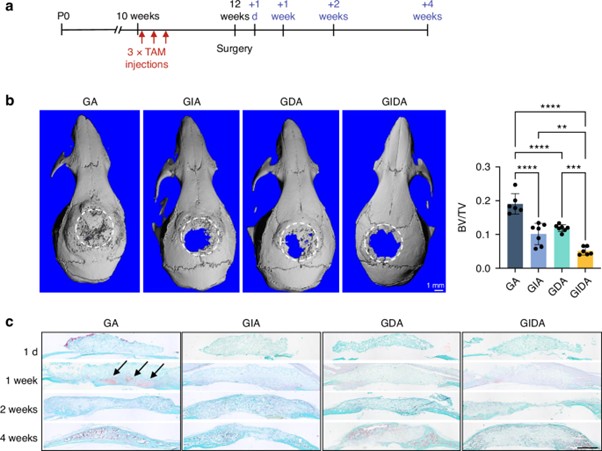
To examine their individual and cooperative roles, the researchers created conditional knockout mice in which they deleted Itgb1, which encodes β1 integrin, Ddr2, the gene encoding DDR2, or both genes in GLI1+ SPCs, a population of skeletal progenitor cells that contributes to bone regeneration. They then created a critical-sized skull defect, treated it with BMP2, a protein that promotes bone formation, and monitored bone regeneration over four weeks.
In control mice with both receptors intact, new bone formed extensively at the injury site, resulting in almost complete healing. Deleting either receptor alone moderately impaired bone formation, reducing bone volume by 47% after Itgb1 deletion and 36% after Ddr2 deletion. Deleting both receptors caused a much stronger effect, reducing bone volume by 73% and leaving only a small amount of new bone.
To understand how the receptors affect SPCs during bone healing, the researchers tracked GLI1+ cells in the regenerating defects. In control mice, these cells migrated from the cranial sutures into the injury site and contributed to the regenerating bone. Loss of either receptor reduced GLI1+ SPC migration and proliferation, with the greatest reduction occurring when both receptors were removed.
The loss of either receptor also impaired SPC differentiation into bone- and cartilage-forming cells. The researchers found reduced levels of markers associated with chondrocytes, preosteoblasts, and mature osteoblasts, with the strongest reduction occurring when both receptors were absent.
The researchers observed related effects in cell-culture experiments. Loss of either receptor reduced cell spreading, disrupted the actin cytoskeleton, and decreased the formation of focal adhesions, which help cells attach to their surroundings and respond to mechanical signals.
Notably, cells lacking DDR2 had less active β1 integrin, suggesting that DDR2 helps promote β1 integrin activation during interactions with collagen. Loss of either receptor also reduced YAP1 localization in the nucleus, where YAP1 helps cells respond to mechanical signals from their surroundings. The effects were strongest when both receptors were absent.
The researchers then used heterozygous cells to determine whether β1 integrin and DDR2 function cooperatively. They inactivated one copy of either Itgb1 or Ddr2, or one copy of both genes, and examined SPC function. Having only one working copy of either gene had little effect. However, when the researchers inactivated one copy of both genes at the same time, SPC function was significantly impaired, providing genetic evidence that the two receptors cooperate.
The findings show that β1 integrin and DDR2 form a cooperative collagen-sensing system in SPCs. Together, they regulate the migration, proliferation, spreading, and differentiation of these cells during cranial bone regeneration, while DDR2 also helps promote β1 integrin activation.
The researchers suggest that targeting both receptors could provide a more effective strategy for enhancing bone repair. “These findings offer new insight into how matrix receptors integrate mechanical and biochemical signals and inform future therapeutic strategies aimed at enhancing cranial bone regeneration in degenerative or injury-related skeletal disorders,” the researchers state in their study.
Reference
Title of original paper: Roles of integrin β1 and discoidin domain receptor 2 in cranial
regeneration and skeletal progenitor cell function
Journal: International Journal of Oral Science
DOI: https://doi.org/10.1038/s41368-026-00455-2
About International Journal of Oral Science
The International Journal of Oral Science publishes peer-reviewed research across all areas of oral science and related interdisciplinary fields, covering basic, applied, and clinical studies. It features Original Articles, Review Articles, Editorials, Correspondence, and occasional invitation-only Special Features. The journal aims to provide a comprehensive platform for new research findings and expert summaries, fostering scholarly exchange within the oral science community.
Website: https://www.nature.com/ijos/
About Professor Emeritus Renny T. Franceschi from University of Michigan, USA
Dr. Renny T. Franceschi is a distinguished researcher and professor at the University of Michigan, with appointments in Dentistry, Biological Chemistry, and Biomedical Engineering. He has published more than 130 research papers on bone and joint formation, including the roles of collagen receptors and tissue engineering in regenerative medicine. His laboratory also develops synthetic scaffolds and cell- and gene-based approaches for bone regeneration. He received the 2008 Distinguished Scientist Award from the International Association for Dental Research (IADR) and was named an American Association for Dental Research (AADR) Fellow in 2019.
Funding information
This work was supported by NIH/NIDCR grant DE029465, Department of Defense Grant CDMRP W81XWH-20-1-0571, research funds from the Department of Periodontics and Oral Medicine, University of Michigan School of Dentistry and the Michigan Musculoskeletal Health Core Center (NIH/NIAMS P30 AR069620).
Yini Bao
The International Journal of Oral Science
email us here
Legal Disclaimer:
EIN Presswire provides this news content “as is” without warranty of any kind. We do not accept any responsibility or liability
for the accuracy, content, images, videos, licenses, completeness, legality, or reliability of the information contained in this
article. If you have any complaints or copyright issues related to this article, kindly contact the author above.

Media gallery