AIM Intelligence Launches Global Physical AI Safety Consortium ‘PASC’
Bringing together experts from Google, Microsoft, Oracle and LG Electronics, alongside researchers from universities

Press Release Disclaimer: This is a press release distributed through the XPR Media network. It has not been independently verified by our newsroom.
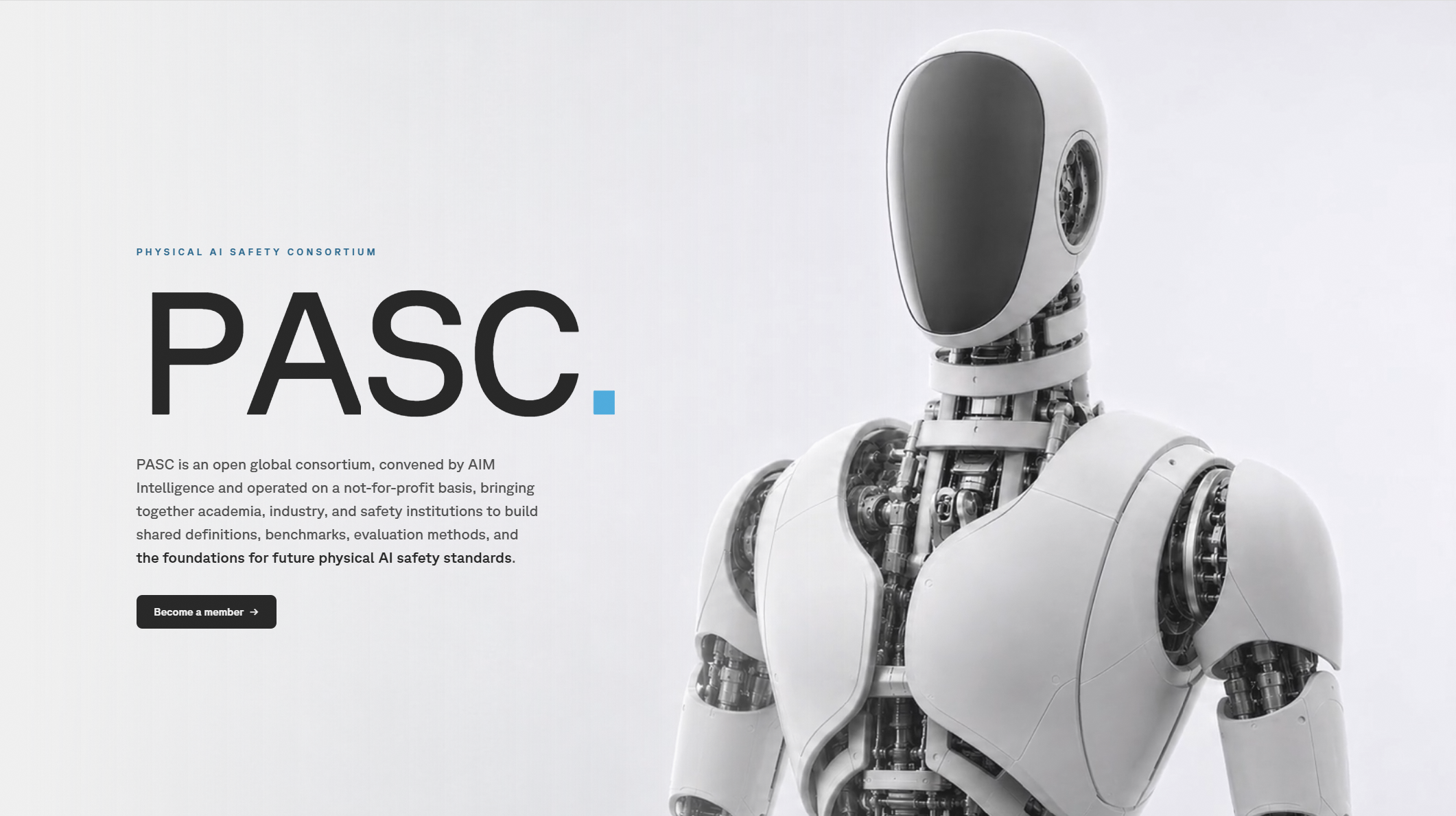

Bringing together experts from Google, Microsoft, Oracle and LG Electronics, alongside researchers from universities and AI safety institutions worldwide
SF, CA, UNITED STATES, September 17, 2026 /EINPresswire.com/ — AI security specialist AIM Intelligence (CEO Sangyoon Yu) announced the launch of PASC (Physical AI Safety Consortium), a global consortium focused on the safety of physical AI systems, including robots and autonomous systems.
Physical AI systems—including robots, autonomous systems, and industrial equipment—make decisions and act in the physical world, going beyond the text responses generated by language models. Safety therefore extends beyond blocking harmful outputs to identifying, assessing, and controlling risks before actions cause harm.
To address these challenges, PASC is a global open consortium that establishes common definitions of physical AI safety, evaluation methodologies, benchmarks, and research foundations necessary for future standardization. PASC is convened by AIM Intelligence and operated on a not-for-profit basis. Individuals and institutions can contribute through research, models, hardware, compute resources, and data.
Currently, PASC includes approximately 30 researchers and industry practitioners, including experts from Google, Microsoft, Oracle, and LG Electronics, as well as researchers from universities worldwide and AI safety research institutes. Key participants include Jenny Ni (Google), Adrian de Wynter (Microsoft, University of York), Hitesh Laxmichand Patel and Amit Agarwal (Oracle), Jiyong Jang (LG Electronics), Myuhng-Joo Kim (Korea AI Safety Research Institute), Sicun Gao (UC San Diego), Sharon Li (University of Wisconsin), and Yaqi Xie (University of Illinois).
As its first joint project, PASC is preparing a position paper addressing the definition and evaluation direction of physical AI safety. Subsequently, the consortium plans to expand activities to include designing joint evaluation systems and benchmarks, adversarial testing in operating environments, and validation research spanning simulation and real robot environments.
Notably, PASC views safety not as a one-time determination but as a state requiring continuous observation, updating, and intervention. To this end, the consortium identifies key research questions: whether risks can be sufficiently defined, whether signs of risk can be detected early enough to intervene , whether evaluation results remain valid across changing environments and robot morphologies, and whether safety systems withstand adaptive attacks.
Haon Park, CTO of AIM Intelligence, stated: “We aim to make PASC a forum that brings together expertise from academia and industry to develop a shared language and a foundation for validating physical AI safety.”
For more information about PASC participation and research, please visit www.pasc-ai.com
Team Cookie Official
Team Cookie
email us here
Visit us on social media:
LinkedIn
Facebook
Legal Disclaimer:
EIN Presswire provides this news content “as is” without warranty of any kind. We do not accept any responsibility or liability
for the accuracy, content, images, videos, licenses, completeness, legality, or reliability of the information contained in this
article. If you have any complaints or copyright issues related to this article, kindly contact the author above.

Media gallery